Refreshing the Bank Branch Experience
An insightful conversation with Adrenaline’s branch refresh expert about maximizing impact while managing costs
Branch Refreshes at a Glance:
- Even in an era of digital convenience, the branch remains one of the most essential brand touchpoints for financial institutions
- M&A often means financial institutions end up with a patchwork layouts and service models, creating an inconsistent user experience at every branch
- Simple changes like paint, carpet and updating millwork can have a big visual impact
- A simple refresh can deliver up to 80% of the impact at a fraction of the renovation cost
Even in an era of digital convenience, the physical branch remains one of the most visible and vital brand touchpoints for banks and credit unions. With online and mobile channels taking on much of the transaction load, branches have become a place for customer connection, trusted guidance, and community impact. Yet for many financial institutions, full branch transformation across their network simply isn’t in the cards – or in the budget. That’s where a strategic branch refresh comes in. More than a simple cosmetic change, a well-executed branch refresh program helps bring brand consistency and elevated experiences into the branch, resulting in renewed opportunities for relationship building across the network.
According to eMarketer’s reporting, many branches need a refresh to meet rising demands for in-person experiences, with a significant amount of those elevated expectations coming from outside banking. Really engaging with customers to understand their lifestage needs and financial goals is key to creating beneficial banking experiences. Even more, customers crave customized and memorable interactions – and that starts with recognizing where the physical environment supports or detracts from that experience. In Adrenaline’s conversation with Brad Parrish, Senior Director of Enterprise Design Integration, we talk about how and when financial institutions should refresh their branches and why it matters now more than ever.
What is the core difference between a branch refresh and a full-scale branch conversion?
A branch conversion usually happens after an acquisition or expansion. That means merging two institutions, rethinking the operational model, and redesigning spaces from the ground up. On the other hand, a refresh is about achieving consistency across an existing network without major construction. Many banks and credit unions have grown through M&A, so you often end up with a patchwork of storefronts, layouts, and service models. That inconsistency creates a different user experience in every branch, and customers can feel that lack of alignment when they walk in the door.
With a refresh, the focus is on creating that sense of familiarity. So whether a customer enters a downtown flagship or a suburban branch, they know they’re in the same bank. Sometimes that includes operational improvements, but often it starts with the visual layer, because that’s the most cost-effective and immediate way to make an impact. We can also phase refreshes over time, based on budget or strategic priorities. Right now, because of market uncertainty, we’re seeing more clients stick with the visual side – paint, signage, finishes – while putting the bigger operational changes on hold until they’re ready to make that investment.
What elements are typically included in a branch refresh?
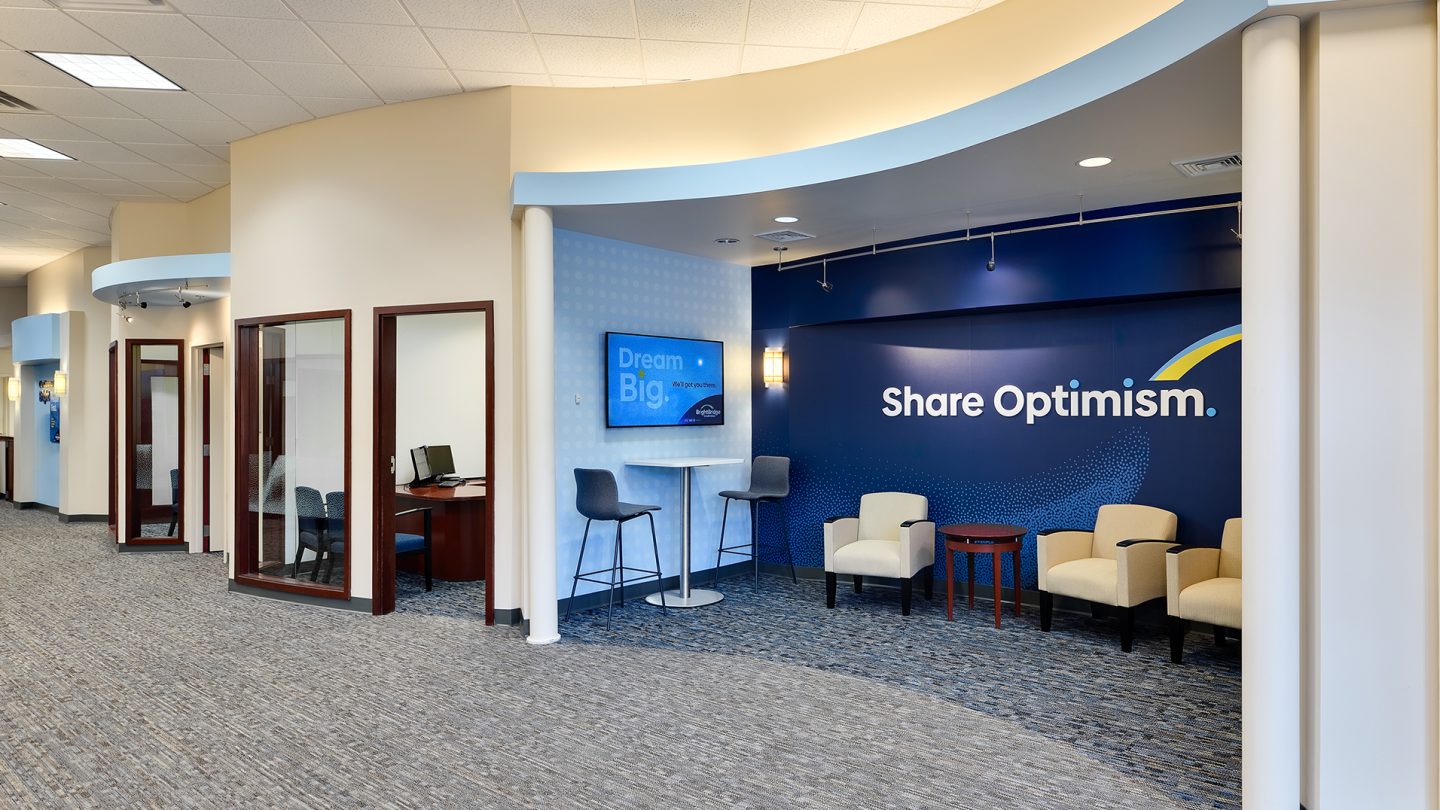
There’s a lot you can do with relatively simple changes. One of the most effective and economical is paint. Accent or focal walls in brand colors make a huge difference, helping signage pop and creating a magnet to draw people in. It keeps the branch from feeling like a sterile office and gives it what I call a “brand hug.” Interior signage is another big part of nearly every refresh. That includes environmental graphics, wall coverings, and compliance banding on office fronts and teller windows. We also recommend updating doors and windows. The layout of hours, holiday messages, or required information should be clear, uncluttered, and on-brand, since that’s often a customer’s first impression before they even walk inside.
Flooring is another common element, and it has become more practical, thanks to modular carpet tiles. You don’t have to tear out an entire floor – just replace worn or stained squares. That brightens a space quickly and cost-effectively. Beyond that, we can update millwork without rebuilding it, using products like laminate to refresh tired or off-brand finishes. All of these changes add up to an environment that feels cared for. Customers notice when a branch is clean and up to date, and it makes them feel more confident about doing business there. Staff notice too. When their workspace looks refreshed, employees feel prouder and more energized, which carries over into better interactions with customers.
How do institutions decide whether to do a light refresh or invest in bigger changes?
A lot of it comes down to budget planning and strategic goals. Through our network assessment process, we provide clients with rough-order-of-magnitude budgets. Those are based on recent projects and give them a realistic view of costs for different scopes of work, whether that’s a light-touch visual refresh or a more involved operational realignment. We then model scenarios with them: what it would take to update a few branches, an entire region, or the whole network, and what the spend looks like per branch. That gives institutions a clear framework to guide their decisions.
Sometimes, clients come to us with a set budget ceiling, and we work strictly within those limits. Other times, they’re more flexible and want to see a range of options: “Here’s what you can do with X dollars, here’s what Y will get you, and here’s what it takes to do everything.” Our role is to put the right information in front of them so they can make the best decision for their organization. In some cases, a simple refresh is enough to achieve 80% of the impact without the cost of a full renovation. In others, particularly at flagship or high-volume branches, a deeper investment in operational upgrades makes sense as part of a longer-term strategy.
To learn more about success strategies for branch refreshes, or to speak with one of Adrenaline’s brand-to-branch experts, contact us today.
Adrenaline is an end-to-end brand experience company serving the financial industry. We move brands and businesses ahead by delivering on every aspect of their experience across digital and physical channels, from strategy through implementation. Our multi-disciplinary team works with leadership to advise on purpose, position, culture, and retail growth strategies. We create brands people love and engage audiences from employees to customers with story-led design and insights-driven marketing; and we design and build transformative brand experiences across branch networks, leading the construction and implementation of physical spaces that drive business advantage and make the brand experience real.