Using Branch Scorecards to Maximize Market Opportunity
A Q&A on branch performance and market opportunity with Nick Mentel, Adrenaline’s Managing Director of Insights & Analytics
Branch Scorecards at a Glance:
- Branch scorecards measure performance in context, comparing results with the market opportunity available to each location
- Scorecarding complements network optimization by identifying near-term opportunities to maximize performance across the existing network
- Market potential and branch role help establish realistic performance expectations rather than applying the same benchmarks across every location
For banks and credit unions, optimizing the branch network has typically meant answering some of the industry’s biggest questions about banking delivery and distribution, from where to maintain or expand presence to which locations should be relocated, renovated, or closed. Once those larger decisions are made, banking leaders’ focus shifts to maximizing the existing branch network. That means understanding how well individual branches are performing within their markets, how much opportunity exists, and whether the bank is capturing its fair share of business. Branch scorecarding helps provide data and direction for the institution’s future.
Branch scorecards bring together market, demographic, competitive, and performance data to help banks and credit unions answer key questions at a more granular level. Rather than evaluating every location against the same universal standard, branch scorecards establish performance expectations based on the opportunity in the surrounding market and the role each location plays within the broader network. To understand how branch scorecards work, we sat down with Nick Mentel, Adrenaline’s Managing Director of Insights & Analytics, to discuss branch performance, network strategy, and how to turn intelligence into action.
What is a branch scorecard, and why should financial institutions be using one?
At its core, a branch scorecard is a way to understand how a branch is performing relative to the opportunity available in the market. Scorecarding moves the conversation beyond simply asking how many deposits or loans a location has and starts asking whether those numbers make sense given the environment around that branch.
A branch with $100 million in deposits might look very successful in isolation. But if the characteristics of its market suggest it should have $150 million, there may be significant untapped opportunity. Conversely, another branch with a smaller deposit base could actually be outperforming what we would expect given the size and characteristics of its market.
Scorecarding gives financial institutions a much more meaningful benchmark because it evaluates performance within context. The goal is to understand not only what a branch is producing, but what it should reasonably be producing.
How does scorecarding fit into the larger branch optimization process?
Traditional network optimization tends to focus on the future shape of the network. It helps an institution determine where it should maintain presence, where it may need to relocate or consolidate locations, and where there are opportunities to expand. Branch scorecarding can be a natural next step. Once an institution has confidence in where it wants to be, the question becomes how to maximize the opportunity in those markets.
That makes scorecarding much more focused on near-term performance. Instead of only creating a longer-term roadmap for what the network could look like five or ten years from now, the scorecarding process can identify opportunities that exist today. Where are we overperforming? Where are we underperforming? Where does the underlying market suggest there is more business to capture?
Scorecarding can also complement an optimization study by giving decision-makers another level of intelligence about where investment should be prioritized across the network.
What factors determine how a branch should be performing?
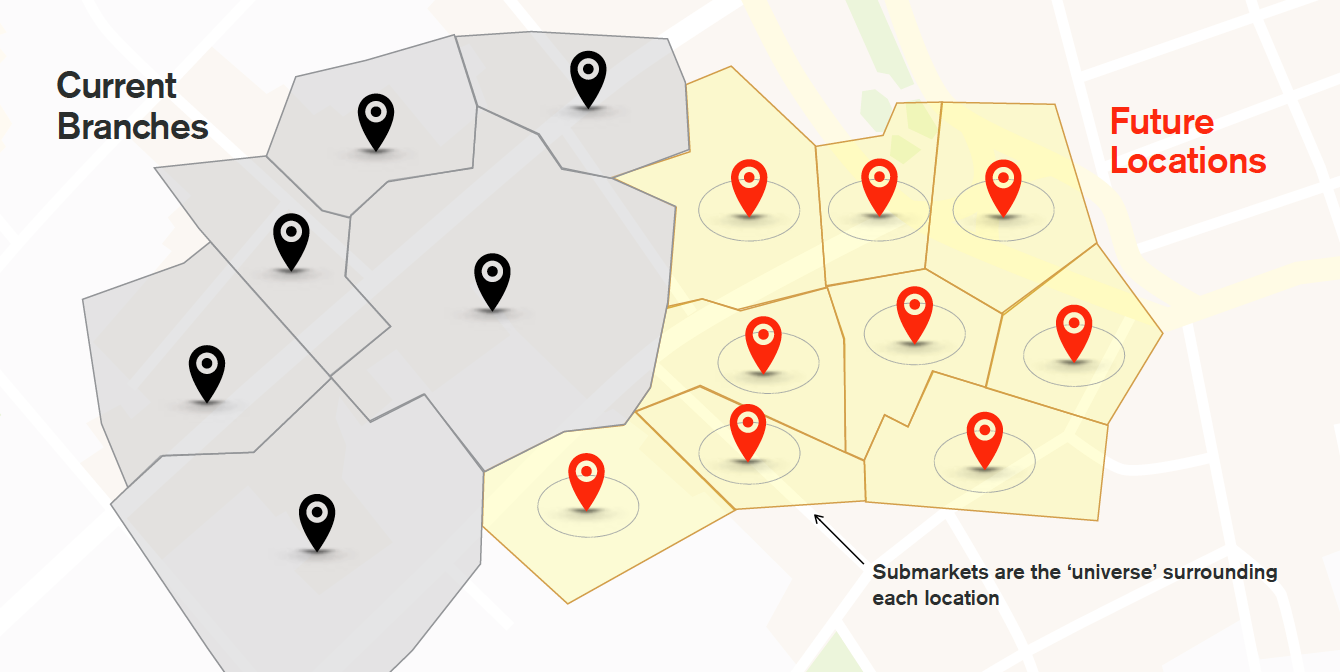
There isn’t one singular metric that tells you the answer for how a bank or credit union branch should perform in a market. Good scorecarding requires looking at the market from multiple angles and understanding the factors that influence the potential of a particular location. That can include the number of households and businesses in a market, household income, deposit and loan potential, competitive density, and the institution’s existing physical presence. The analysis can move from a broad market view down to individual micro markets and ZIP codes, allowing us to understand how opportunity changes across a network.
The line of business matters, too. A branch located in a strong commercial corridor may have a very different opportunity profile from one serving a predominantly consumer market. And those differences can influence the role the branch plays across the network. One location may be particularly important for business banking, while another may be positioned to capture consumer households or support growth in an emerging market. Understanding that role is an essential part of establishing realistic expectations for performance.
The point isn’t to establish a universal definition of a successful branch, but to understand what success should look like for that particular location.
Why can’t every branch in a network be measured against the same benchmarks?
Every branch doesn’t have the same job, and every market doesn’t present the same opportunity. One market might have twice as many households as another. Another may have a larger concentration of businesses or a more affluent consumer base. Competitive intensity can vary significantly from one market to the next. Newer branches also need to be evaluated differently from mature locations that have had years to establish customer relationships.
There is also the role each location plays within the network. A branch isn’t simply an individual point on a map. Branch purpose is shaped by where it is, who it serves, and how it connects with the rest of the network. That means two branches within the same institution can be successful in very different ways. All of those differences should influence expectations. A financial institution can certainly establish network-wide goals, but applying identical performance benchmarks to every branch can obscure what’s really happening.
The more useful question is whether each branch is capturing the opportunity available to it and fulfilling the role it is positioned to play in the network. That’s what allows an institution to distinguish between a branch that simply produces a large volume and one that is truly performing well relative to its potential.
What can a scorecard reveal that traditional branch performance metrics can’t?
Traditional performance data tells you what happened. Scorecarding adds another layer by helping explain what those results mean. If a branch is growing deposits, that’s useful information. But how quickly is the overall market growing? How much competitive share does the institution have? How deeply has it penetrated the households and businesses surrounding the location? Is the branch benefiting from sufficient network density? And how does actual performance compare with the deposit and loan potential available in that market?
Those questions can reveal very different types of opportunities. A financial institution may find a market where it already has a strong physical presence but isn’t capturing its expected share. It may identify another where performance is strong despite relatively limited penetration, suggesting additional investment could produce even more meaningful growth.
That is where scorecarding becomes more than measurement. It starts helping the institution identify where it has room to move.
How should financial institutions turn branch scorecard insights into action?
The value isn’t in producing a score, but in what the institution does with the intelligence underpinning that score. Scorecards can help leaders prioritize markets and branches, establish more realistic performance goals, and determine where additional resources could have the greatest impact. Depending on what the analysis reveals, that might mean greater sales focus, marketing support, business development, or additional investment in the branch experience in a particular market.
At the same time, scorecards shouldn’t be treated as an inflexible formula. Quantitative analysis is extremely powerful, but there will always be qualitative factors and local market knowledge that add context and meaning to the scorecard. Geographic boundaries aren’t perfect, customers don’t always behave according to neatly defined territories, and markets continue to change.
The strongest approach combines robust data with institutional knowledge. Scorecarding gives leaders a much stronger foundation for those decisions, replacing broad assumptions about branch performance with a clearer understanding of market potential. Ultimately, branch optimization isn’t finished when an institution determines where its branches should be. The next opportunity is making sure those locations are working as hard as they can in the markets they’re designed to serve.
For more information on branch scorecarding as part of branch optimization for growth, contact us today.
Adrenaline is an end-to-end brand experience company serving the financial industry. We move brands and businesses ahead by delivering on every aspect of their experience across digital and physical channels, from strategy through implementation. Our multi-disciplinary team works with leadership to advise on purpose, position, culture, and retail growth strategies. We create brands people love and engage audiences from employees to customers with story-led design and insights-driven marketing; and we design and build transformative brand experiences across branch networks, leading the construction and implementation of physical spaces that drive business advantage and make the brand experience real.